
A switchback is a zigzagging trail that lets you ascend or descend a steep slope without clawing your way straight up the mountain. Instead of attacking a hill head-on, the path cuts back and forth across the slope in sharp 180-degree bends, transforming an exhausting vertical climb into a series of manageable, gradual segments.
If you’ve ever wondered why some trails seem to wander endlessly back and forth instead of taking the obvious straight route to the top, you’ve discovered one of the smartest pieces of trail design in the outdoor world. Those switchbacks aren’t there to make your hike longer or test your patience. They’re engineered to make steep terrain accessible, protecting both your knees and the mountain itself.
Here in New England, where our trails climb everything from gentle wooded hills to rocky summits, understanding switchbacks changes how you approach a hike. The concept is simple: by heading across the flanks of the slope rather than straight up, the gradient becomes far more gradual. What might otherwise feel like scaling a wall turns into a steady, sustainable climb that won’t leave you gasping for air halfway up.
But there’s more to switchbacks than just making your life easier. These carefully planned trail segments prevent erosion, preserve fragile plant communities, and keep trails from turning into muddy gullies after every rainstorm. When you stick to the switchbacks instead of cutting across them, you’re not just following trail etiquette. You’re helping preserve the trail for everyone who’ll hike it after you.
What Switchbacks Really Mean on the Trail
When you’re climbing a steep mountain trail and the path suddenly makes a sharp hairpin turn, then another, then another, you’re experiencing switchbacks in action. A switchback is a 180-degree bend in a trail that reverses your direction of travel, creating a zigzag pattern as you move up or down steep terrain. Instead of marching straight up a mountainside, you’re traveling back and forth across its face, gaining elevation gradually with each turn.
Think of it like climbing a staircase versus scaling a ladder. The switchback takes what would be an exhausting straight-up climb and transforms it into a series of angled paths that work with the mountain’s contours rather than fighting against them.
- Switchback
- A 180-degree bend in a trail that reverses your direction of travel, creating a zigzag climbing pattern on steep slopes.
- Gradient
- The steepness or angle of the trail’s incline, which switchbacks reduce by spreading elevation gain over a longer distance.
- Zigzag Pattern
- The back-and-forth routing created by multiple switchbacks, resembling the letter Z repeated up a mountainside.
- 180-Degree Turn
- The sharp hairpin bend where the trail doubles back on itself, reversing your uphill or downhill direction.
This definition comes from North American trail terminology, where “switchback” specifically describes these sharp reversing turns. When you’re on the trail, you’ll recognize them instantly. The path angles across the slope, reaches a tight corner where you’ll nearly reverse direction, then continues across the mountain face in the opposite direction. Each leg of the zigzag gains you a bit more elevation without the grueling intensity of a direct ascent.
The beauty of this design is that by heading across the flanks of the slope rather than straight up, the gradient becomes noticeably more gradual. You’re still climbing the same mountain, but you’re taking a longer, gentler route to get there.
How Switchbacks Make Steep Climbs Possible
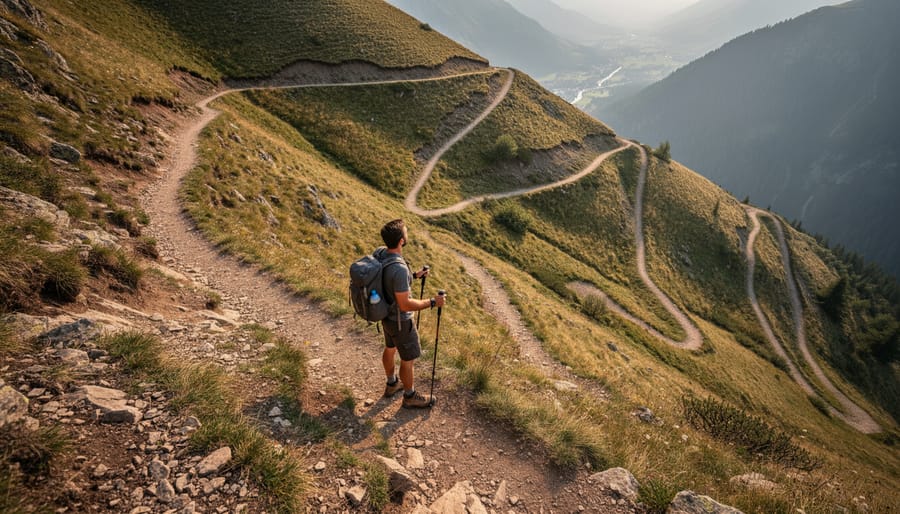
Picture yourself standing at the base of a mountain, staring up at what looks like an impossibly steep wall of earth and rock. A trail that goes straight up would be brutal, maybe even dangerous. This is where the genius of switchback design reveals itself.
Instead of attacking the slope head-on, switchbacks take the path of intelligent resistance. They traverse diagonally across the face of the mountain, then make a hairpin turn and head back the other direction. Think of it like climbing a staircase versus scaling a ladder, both get you to the same height, but one asks far less of your body.
The magic happens in the geometry. When you’re walking across the flank of a slope rather than straight up it, gravity isn’t pulling quite so hard against every step. Your legs do steady work rather than explosive effort, and your cardiovascular system can settle into a rhythm instead of gasping for oxygen.
You’ll cover more horizontal distance to gain the same elevation, sure. A straight-line climb might be half a mile, while switchbacks could stretch that to a mile or more. But here’s the trade-off that matters: you’ll actually finish that climb without your quads screaming or your heart hammering out of your chest.
On the descent, the principle flips but remains just as valuable. Switchbacks prevent you from picking up dangerous momentum and spare your knees the pounding they’d take on a direct downhill route. That zigzag pattern keeps you in control, step after step, all the way down.
This is why you’ll find switchbacks threading up nearly every substantial peak worth hiking. Trail builders aren’t just being creative, they’re applying physics to make the mountains accessible to anyone willing to put in the miles.
What Switchbacks Do for Your Hiking Experience
When you’re grinding up a steep mountain trail in the Monadnock region, switchbacks transform what could be a punishing scramble into a manageable climb. Instead of attacking a slope straight on, these zigzagging paths spread the elevation gain across a longer horizontal distance, making the gradient gentler and the effort sustainable.
The practical payoff shows up immediately in your legs and lungs. On a direct ascent, your heart rate spikes and your quadriceps burn within minutes. Switchbacks let you settle into a steady rhythm, conserving energy for the miles ahead rather than exhausting yourself on one brutal pitch. This matters especially on longer hikes around Chesterfield, where you might cover significant elevation over several hours.
Switchbacks deliver measurable benefits for every hiker:
- Reduced physical strain by spreading elevation gain across gentle grades
- Improved safety through stable footing and controlled descent angles
- Accessibility for families, older hikers, and those building fitness
- Sustainable trail design that channels foot traffic and prevents erosion
Beyond making the climb easier, switchbacks open up terrain that would otherwise be off-limits. Steep mountainsides in the White Mountains and Green Mountains become hikeable for a much broader range of people. A trail that climbs from valley to summit via switchbacks welcomes families with kids, hikers returning from injury, and anyone who wants the views without technical scrambling.
The mental game shifts, too. Rather than staring up at an intimidating wall of rock and roots, you focus on the manageable segment ahead. Each turn brings a small victory and often a fresh perspective on the landscape. That psychological boost keeps you moving when the summit still feels distant, turning what could be discouragement into steady progress.
Different Types of Switchback Trails You’ll Encounter
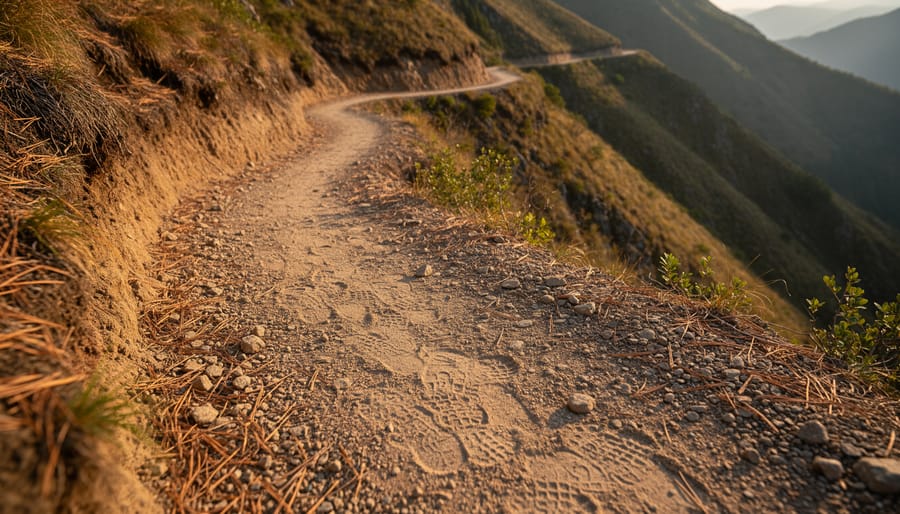
Out on the trail, you’ll discover that no two switchback systems feel quite the same. The design and experience vary based on the mountain’s personality, the trail builder’s approach, and what the terrain allows.
Gentle switchback climbs create a relaxed zigzag pattern where each turn feels almost leisurely. You’ll find these on trails where the slope isn’t punishing but still too steep for a straight path. They let you settle into a comfortable rhythm, chatting with hiking partners between turns. Fundy National Park features switchback climbs like these on portions of their trail network, where the ascent feels more like a conversation with the mountain than a battle.
Steeper switchback sections pack the turns closer together, with sharper angles between segments. These demand more focus as you navigate tighter corners and feel the gradient more acutely in your legs, even though the switchbacks are doing their job. The Tonquin Valley Trail in Jasper National Park demonstrates this progression beautifully: it starts with a gentle climb for the first three kilometers before climbing more steeply toward Switchback Campground at kilometer 13.6, where the elevation reaches 2,067 meters.
Terrain shapes everything about how switchbacks get built. Rocky mountainsides create opportunities for dramatic, carved switchbacks with stone underfoot. Forest slopes allow trail builders to weave between trees, using natural anchors to stabilize each segment. Open alpine environments might feature longer switchback runs across exposed flanks, while dense vegetation requires tighter, more frequent turns.
You’ll also notice differences in how long each segment runs before the next turn. Some switchbacks give you fifty paces of straight walking, while others flip direction after just a dozen steps. The mountain decides what works, and trail builders respond with what the landscape can support sustainably.
Why You Should Never Cut Switchbacks
When you spot a shortcut between switchback bends, it might be tempting to shave a few minutes off your hike. But cutting across switchbacks is one of the most damaging things you can do on the trail.
Those seemingly innocent shortcuts destroy the soil and vegetation that hold the hillside together. Each time someone cuts a switchback, they trample plants that prevent erosion and compact the soil beneath their boots. What starts as a faint track quickly becomes a gully as rain washes down the exposed dirt. Before long, that shortcut erodes into a scar that sends sediment into streams and widens with every storm.
Parks like Kings Throne in Kluane National Park specifically ask hikers to stay on the switchbacks and avoid shortcut trails to prevent erosion. The damage spreads fast once it starts, and restoration work is expensive and time-consuming.
Sticking to switchbacks is part of hiking with Leave No Trace principles. When you stay on trail you’re protecting the landscape for everyone who comes after you. Plus, those zigzags genuinely make the climb easier on your knees and lungs.
The extra few minutes you spend following the switchbacks help preserve the trail for decades. That’s a trade-off worth making every time.
Insider Tips for Hiking Switchbacks
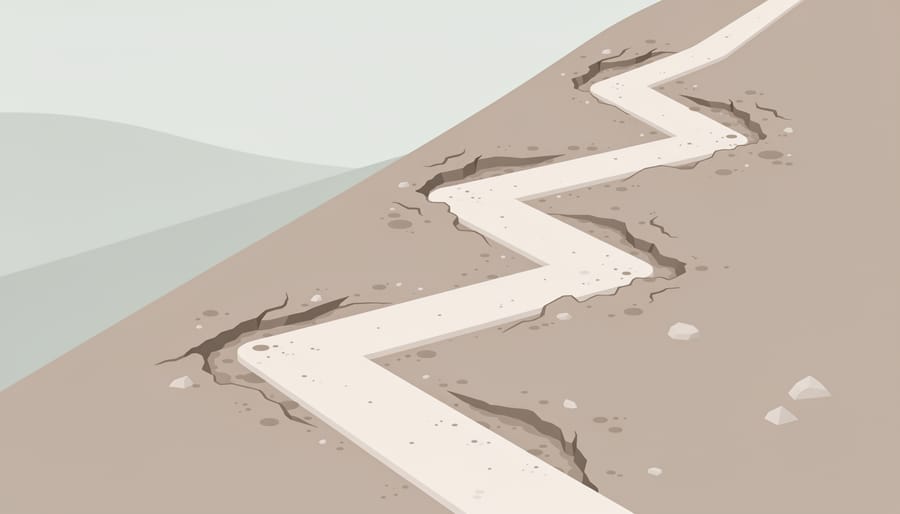
After years of watching hikers tackle the trails around Chesterfield and throughout New Hampshire’s White Mountains, I’ve noticed that switchbacks can become surprisingly meditative once you develop a rhythm. The key lies in treating each zigzag as its own small victory rather than fixating on how many turns remain above you.
Start with a steady, sustainable pace from the first turn. Many hikers make the mistake of charging up the initial switchbacks, only to burn out halfway through the climb. Think of it as a conversation pace, you should be able to talk without gasping, even on steeper sections. When the trail turns back, use those few steps on flatter ground to take a slightly deeper breath and reset your stride.
Trekking poles transform the switchback experience, especially on trails like Mount Monadnock where you’ll encounter dozens of turns over rocky terrain. Plant your poles on the outside of each curve to maintain balance, and let them take some weight off your knees on the descent. The poles also help you establish that consistent rhythm, almost like a metronome keeping time with your steps.
Here are practical strategies that work on Chesterfield-area switchbacks:
- Pause briefly at every third or fourth turn to check the weather and enjoy the changing perspective
- Shorten your stride on steeper sections rather than pushing harder
- Look at the trail segment ahead of you, not the distant summit
- On descent, lean slightly forward and keep your knees soft to absorb impact
- Use the outer edge of each turn as a natural rest spot to glance back at your progress
The mental game matters as much as the physical. Those endless zigzags can feel monotonous, particularly on trails with tight, frequent turns. Instead of counting switchbacks, notice how the forest changes with elevation, the shift from hardwoods to conifers, the temperature drop, the way sounds carry differently. Each turn reveals a slightly different slice of the landscape, turning repetition into discovery.
Common Questions About Switchbacks
What is a switchback in hiking?
A switchback is a zigzagging trail that makes a 180-degree bend, typically used to ascend or descend steep slopes. By heading across the flanks of the slope rather than straight up, the trail transforms a steep gradient into a more gradual, manageable climb.
Why shouldn’t you bypass switchbacks?
Cutting between switchbacks damages both the soil and plant life, making the area susceptible to further erosion damage. Trail managers at places like Kings Throne in Kluane National Park specifically ask hikers to stay on switchbacks to prevent this environmental harm and maintain trail sustainability for everyone.
How do switchbacks reduce trail difficulty?
Switchbacks reduce the intensity of ascents and descents by creating a longer, more gradual path up the slope instead of a direct, steep climb. This makes the trail accessible to hikers of varying skill levels and helps conserve your energy over long climbs.
What should I do if I lose the switchback trail?
If you realize you’ve wandered off the designated switchback path, stop and carefully work your way back to the last point where you were certain of the trail. Understanding what to do if lost before you head out can help you stay calm and make smart decisions on unfamiliar terrain.
These questions come up often because switchbacks are such a distinctive feature of mountain trails, yet many hikers encounter them without fully understanding their purpose. When you know why these zigzagging paths exist and how they work, you’ll appreciate them more on your next steep climb through the Chesterfield region or any mountainous terrain. Respecting switchbacks means respecting the trail itself and everyone who’ll hike it after you.
Switchbacks might slow you down, but they’re what make the mountaintop within reach. These zigzagging trails represent thoughtful design that transforms steep, impossible slopes into manageable journeys anyone can tackle. They conserve your energy, protect fragile hillsides from erosion, and open up terrain that would otherwise remain off-limits to all but the most extreme climbers.
Next time you’re winding up a Chesterfield-area trail or exploring the mountains beyond, take a moment to appreciate the switchbacks beneath your boots. They’re not obstacles, they’re your allies in the climb. Stay on the designated path, resist the temptation to cut between those bends, and know that your choice helps preserve these trails for everyone who follows.
The mountains are waiting, and switchbacks are your invitation to explore them sustainably. See you on the trail.