
The KLOW peptide blend is a combination of four research peptides studied together, most often in discussions of tissue repair, recovery, and the body’s response to stress. Think of it as four different tools in one toolbox, each explored for its own role in how cells signal and rebuild.
Why does that matter on a site about trails, lakes, and mountain weekends? Because anyone who spends real time outdoors eventually wonders how the body bounces back after a long climb or a tough season, and KLOW comes up more and more in that conversation. This overview breaks the blend down in plain language: what each of the four peptides is, how researchers think they work, and what they’re being studied for. We’ll also be straight about the limits of the evidence, since much of it is still early.
Think of this as a trailhead map, not a summit claim. You’ll leave knowing what the name means and what questions are still open.
What KLOW Means: A Plain-Language Definition
Peptides 101 for Curious Adventurers
Think of peptides as tiny messengers on the trail. They’re short chains of amino acids, the same building blocks that make up the proteins in your body, just far fewer of them linked together. Proteins are the long, complex chains; peptides are the compact ones. If you’re curious about the difference between peptides and proteins, the key idea is length and complexity.
Researchers study peptides because their small size lets them act as signals, helping cells “talk” to one another. That makes them interesting for studying how the body repairs and maintains itself. Here are a few beginner terms that will help as you read on:
- Peptide
- A short chain of amino acids that can act as a signal between cells.
- Amino acid
- A small building block that links together to form peptides and proteins.
- Blend
- A formulation that combines more than one peptide in a single mixture.
- Signaling
- The way cells pass messages to each other to guide activities like repair.
- In vitro vs. in vivo
- In vitro means studied in a lab dish; in vivo means studied in a living organism.
Keep “in vitro” and “in vivo” in mind, because they come up whenever researchers describe what a study actually found.
How the Four-Peptide Blend Works: What Researchers Are Exploring
Picture a four-person trail crew heading out to repair a washed-out section of path. One person clears debris, another hauls gravel, a third shapes the tread, and the fourth checks that everything drains properly. No single worker could do the whole job well, but together they cover each step. That’s a handy way to think about why researchers are curious about a blend like KLOW.
Peptides work as signals. Cells release and respond to them the way a crew responds to a trail boss calling out directions. When a peptide fits a receptor on a cell’s surface, it can nudge that cell toward a particular activity, such as changing how it handles inflammation or how it participates in tissue maintenance. The details differ for every peptide, and that’s exactly the point of studying them.
The interest in combining four peptides comes from a simple idea. The body’s repair and recovery processes involve many pathways running at once, so a blend might, in theory, touch several of them together instead of just one. Researchers sometimes call this a multi-target approach. Some laboratory and animal studies on the individual components point in encouraging directions, and that’s what draws attention to the combination.
Here’s where we have to be careful, though. Seeing something in cell cultures or animal models is very different from showing it works the same way in people. Most of what’s described about the blend as a whole is still hypothesis: the idea that the four peptides could complement each other is plausible, but it hasn’t been confirmed by large, well-controlled human trials. Whether the combination does more than its parts do alone is an open question.
So the honest summary is this: the crew analogy explains the thinking behind the blend, not a proven result. Treat the mechanism as a promising area of research, not a guarantee of any health outcome, and keep an eye on new studies as they appear.
Meet the Four Peptides: Components of the KLOW Blend
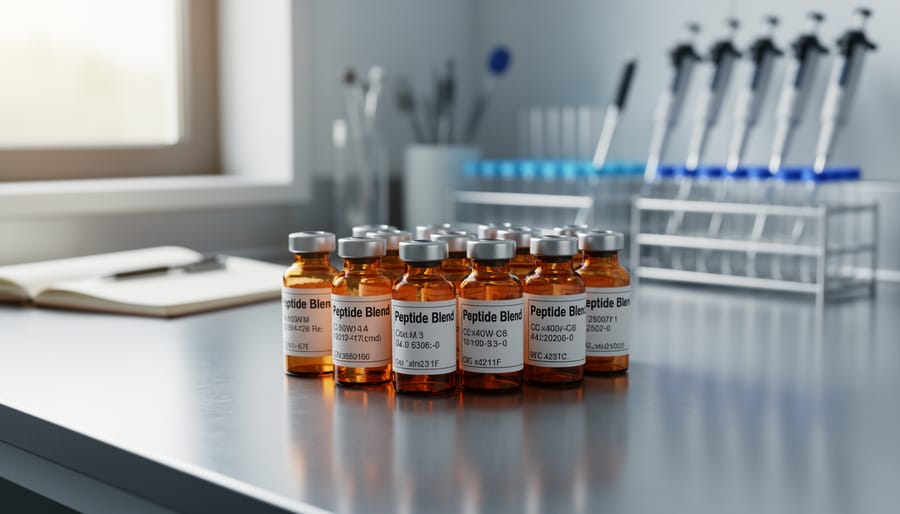
Here’s where the curiosity really gets rewarded. KLOW is generally described as a blend of four peptides, and the names you’ll see most often are GHK-Cu, BPC-157, TB-500, and KPV. Think of them as the four members of that trail crew, each with a different tool in the pack.
One honest note before we walk through them: the details behind each one vary by source, and much of what’s published comes from laboratory and animal studies rather than large human trials. So treat the descriptions below as “what researchers are exploring,” not “what it does.”
- GHK-Cu is a small copper-binding peptide studied for its role in skin and tissue remodeling.
- BPC-157 is a peptide sequence derived from a protein found in stomach fluid, studied mostly in animal models for tissue repair.
- TB-500 is a synthetic fragment related to thymosin beta-4, studied for its possible role in cell movement and tissue healing.
- KPV is a short fragment of a natural hormone, studied for its potential effects on inflammation signaling.
GHK-Cu has probably the longest research history of the four. It occurs naturally in the body, and studies have looked at how it might influence collagen and wound-related processes. BPC-157 gets plenty of attention in recovery conversations, but it’s worth knowing that most of the evidence is preclinical, meaning it comes from lab work and animals, so human data remains limited.
TB-500 and KPV sit in a similar spot. Researchers find them interesting because of what they might do in the body’s repair and inflammation pathways, yet the published picture is still developing. You may also see slightly different descriptions of TB-500 depending on where you read, which is a good reminder to lean on primary sources when you can.
The idea behind combining them is simple and appealing: if each peptide touches a different part of the repair conversation, researchers wonder what happens when they’re studied together. Whether the blend works better than its parts is still an open question, and the evidence to answer it isn’t fully in yet. Staying curious while keeping your expectations grounded is the smart way to follow this research, a lot like reading a trail map before heading out.
How KLOW Is Used: Research Applications and Real-World Context

Researchers talk about blends like this in a handful of specific areas, and it helps to know where each one sits on the evidence ladder. Everything below is a topic under investigation, not a proven result:
- Tissue repair and wound healing: mostly early lab work and animal studies.
- Soft-tissue recovery, such as tendon and muscle models: largely animal studies, with very little human data.
- Inflammation-related pathways: early lab work, with some limited human data on individual peptides.
- General recovery and resilience after physical stress: mostly theoretical, with small or preliminary human observations.
Notice the pattern. The further you move toward real people living real lives, the thinner the evidence gets. Studies in cells or animals can point researchers toward good questions, but they can’t tell us whether the same thing happens in a hiker’s sore knees or a cyclist’s tired legs.
So why would an outdoors crowd hear about any of this? Because active folks care about bouncing back. If you’ve ever finished a long ridge hike, set up camp with aching feet, and wondered how to feel fresh for tomorrow’s miles, you know why recovery research draws curiosity. It’s also why conversations about recovery on the trail tend to cover sleep, hydration, food, and mindset long before anyone mentions peptides. Those basics have decades of evidence behind them.
One important note: KLOW is discussed in research contexts, and the science is still developing. Nothing here is a recommendation or a promise of results. If you’re curious about it, or about any recovery approach, talk with a qualified healthcare professional who knows your health history. They can help you weigh what’s known, what isn’t, and what makes sense for you. This overview is for general education and doesn’t replace medical advice.
Common Questions About KLOW
Curious readers tend to circle back to the same handful of questions, so here are straight answers.
Is KLOW legal, and is it a supplement?
KLOW is generally discussed as a research-use blend, not a dietary supplement, and rules vary by country and by how a product is labeled and sold. Check current regulations where you live before assuming anything.
Is KLOW safe?
Safety hasn’t been established through large human trials, so it’s best to treat claims of safety (or danger) with caution. Early research is not the same as proven outcomes.
How is it different from single-peptide products?
A blend combines four peptides, which researchers study for possible interactions. A single-peptide product looks at one compound on its own, so the results aren’t directly comparable.
Where can I find reliable research?
Start with primary sources like peer-reviewed journals and public research databases, and be wary of sellers summarizing studies for you.
If you have a personal health question, a qualified healthcare professional is the right person to ask. They can look at your history, your goals, and anything you’re already taking, which no article can do. And while the science develops, the basics still carry the most weight. Plenty of recovery and rest after a big day outside, plus good food and water, is a trail-tested foundation that doesn’t depend on any new research.
So, what is KLOW? It’s a four-peptide blend that researchers are still exploring, and the picture will keep changing as new studies come in. Staying curious while checking the evidence is the smartest trail to follow. Look for primary sources, ask qualified healthcare professionals your questions, and be a little skeptical of anything that sounds too good to be true.
Meanwhile, the proven foundations of recovery haven’t changed. Good sleep, steady nutrition, plenty of water, and smart preparation will do more for your legs after a long hike than any buzzword. Even small habits count, like a quiet walk under the pines for stress relief or a bit of campsite hygiene so you wake up feeling fresh.
Ready to put that into practice? Lace up your boots and explore Chesterfield’s trails, then fuel up at a local farmers’ market and check the calendar for community events. Fresh air, good food, and good company are a recovery plan worth sharing.